11th March 2026 (London), Seraphim alongside SECNEWGATE hosted a roundtable discussion bringing together investors, policymakers, and industry participants to discuss the evolution of the space sector and the UK’s role within it.
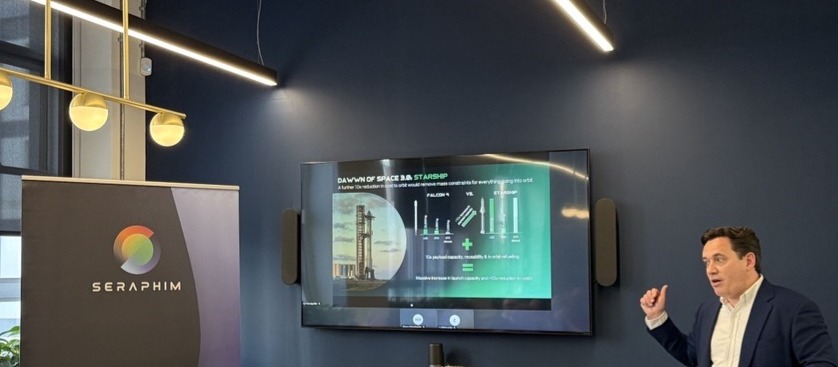
The event was opened by a presentation from Rob Desborough, General Partner at Seraphim, which set the tone around the current investment landscape and emerging opportunities in the sector. The roundtable was then chaired by Will Whitehorn, Chair of the SSIT Board, guiding a discussion that explored the strategic, commercial, and policy dimensions of the sector.
The discussion convened a diverse mix of stakeholders, from government and Parliament, to institutional investors, space companies, financial institutions, and industry bodies such as UKspace. Senior figures from asset management, banking, venture investment, policymakers, economic advisers, and founders building space‑enabled businesses were all represented. This cross-sector participation allowed the conversation to explore the sector from multiple angles, spanning capital markets, industrial strategy, technology development, and emerging commercial applications.
Space now represents a fundamental economic, defence, and growth engine. The global market is already valued at over US$600 billion and is growing at nearly 8 % per year, with forecasts suggesting it could reach US$1.8 trillion by 2035. Investment momentum is accelerating, with more than US$12 billion expected to flow into private SpaceTech in 2025, marking a robust recovery and a new high-water mark in deal activity after the 2022 slowdown.
Crucially, the growth of AI and other advanced technologies is now dependent on space infrastructure: large-scale AI models require vast volumes of data, high-speed global connectivity, and reliable satellite-enabled communications. Without the networks, sensors, and platforms provided by SpaceTech, the AI revolution cannot fully scale, making space an essential backbone for the next wave of technological innovation.
One of the most striking markers of this growth is SpaceX, the world’s most valuable private space company. Recent transactions and strategic moves, including reported tender offers and merger activity, have valued SpaceX in the hundreds of billions of dollars, with expectations it could go public in 2026 seeking a valuation around US$1.5 trillion, potentially one of the largest IPOs in history.
For the UK, the space economy offers significant economic growth potential, a chance to help close defence capability gaps, and the ability to build a domestic ecosystem that supports future high-growth sectors like life sciences. With its heritage as the world’s financial centre, the UK provides world-leading market liquidity, supported by transparent regulation, robust legal infrastructure, and a tradition of legal certainty.
The ambition is clear: the UK should be where space economy deals are made, where investors locate, companies on-shore, and where companies list. Yet the global space economy is unique, high-growth, fast-moving, and at the intersection of innovation and risk. Scaling space businesses requires specialised financial solutions and support, and while the US currently sees the lion’s share of deals, no single centre yet offers the comprehensive financial services ecosystem the space economy will ultimately demand. This context formed a key backdrop for yesterday’s discussions.
1. Space valuations and market maturity
The roundtable opened with a discussion of SpaceX’s valuation and what it signals for the wider ecosystem.
While there was debate on how headline valuations should be interpreted, the consensus was clear: space has moved from a speculative frontier to an enabling technology integrated into multiple industries.
Investment data from the Seraphim Space Index shows the sector attracting strong capital flows across stages, with more than 600 deals over the trailing 12 months to Q4 2025 and total funding exceeding US$12 billion, broadly surpassing previous peaks in the market.
This broad investor confidence, reflected in deal‑making, funding diversity, and rising average deal sizes, indicates that risk perceptions have evolved. Value creation is increasingly concentrated downstream, in areas like:
- Data and analytics
- Software and services
- Integration of space insights into industrial and government workflows
This reflects a maturing market, where recurring revenues, long‑term contracts, and defensible customer relationships matter more than technological novelty.

2. The UK’s position: capability without coordination
Participants agreed the UK has genuine strengths: a strong regulatory environment, expertise in satellite communications and data, and established international partnerships.
However, these advantages are not consistently translating into scaled companies or durable investment outcomes. Challenges include fragmented government policy, slow defence and security procurement, and limited strategic alignment across departments.
While a fully sovereign end‑to‑end programme may not be realistic, the UK has a significant opportunity to position itself as a globally competitive platform for space‑enabled businesses. Achieving this would require clearer prioritisation, more predictable procurement, and a strong signal of long‑term commitment to the sector.
3. Capital allocation and pensions
A recurring theme was the limited flow of UK pension capital into space and other strategic growth sectors.
Compared to markets such as the US and Canada, UK investors are often constrained by short‑term cost minimisation and regulatory structures that penalise longer‑duration, high‑growth investment. These “unintended consequences” mean UK innovation is frequently funded, scaled, and ultimately captured overseas. Without reforms to mobilise domestic institutional capital, the UK risks remaining a net exporter of intellectual property and talent in strategically important sectors.
4.Commercial‑first and dual‑use models
Many of the most successful space companies begin with a clear commercial use case, building scalable, cost‑efficient capability before expanding into defence and sovereign markets.
Earth observation, radar, and thermal data were highlighted as examples where commercial demand drives scale and revenue, and only later enables sovereign adoption. Defence relevance is increasingly a by‑product of commercial scale, rather than the initial design criterion.

5. Climate, resilience, and insurance
Space‑enabled data is unlocking new applications in climate monitoring, urban heat mapping, disaster response, and insurance underwriting. Low Earth orbit satellite constellations, combined with higher revisit rates and near‑real‑time delivery, are making previously impractical applications now feasible.
These use cases address systemic challenges that sit at the intersection of public and private value, while also supporting clear commercial business models. As a result, space companies are becoming embedded in critical decision‑making processes, rather than operating as peripheral data providers.

6. The investor education gap
Despite progress, many generalist investors still associate space primarily with launch risk and technical failure, rather than data products, recurring revenue, and long‑term contracts.
Participants stressed that improving investor literacy, through clearer narratives, better visibility, and comparable benchmarks, is vital for unlocking broader pools of capital beyond specialist funds.
Conclusion
The discussion concluded that space is already investable, scalable, and strategically important. The sector’s technology risk has been largely addressed, and the current constraints lie in policy clarity, capital mobilisation, and market understanding.
Addressing these challenges does not require radical intervention. Rather, it requires clear strategic intent, stronger alignment between public and private actors, and a willingness to treat space as a foundational layer of the modern economy.
With the UK’s financial infrastructure, regulatory certainty, and access to capital, the country has the potential to become the global hub for space economy investment, where companies locate, raise capital, and list — while supporting high‑growth industries across the economy.
We look forward to continuing the conversation at upcoming Seraphim Space events and will share further details soon.