TL;DR / Executive Summary
- Seraphim portfolio company Zenithon has introduced Nova, the first world model designed for extreme physics.
- Nova has been demonstrated in fusion, where it can replace hours-long simulations with predictions produced in seconds.
- Beyond fusion, this approach could help engineers explore more designs, test different operating conditions and identify promising options before committing to costly simulations or hardware.
The technologies that will define the coming decades demand control over increasingly complex physics. They bring together processes that interact across many scales of space and time. Designing them means searching a vast space of possibilities. Each simulation or experiment tells us how a design behaves and what to try next, but the cost of that iteration limits how far we can explore. Making this loop faster would let us develop better technologies and bring them into the world sooner.
World models offer a way to accelerate this search. From real or simulated observations of a system, a world model learns how it evolves and how it responds to actions; once trained, it takes a current state and a sequence of actions and generates what comes next, in a fraction of the time a conventional simulator would take. Extending this capability to extreme physics means learning how plasmas, turbulent flows and electromagnetic fields interact across widely different conditions.
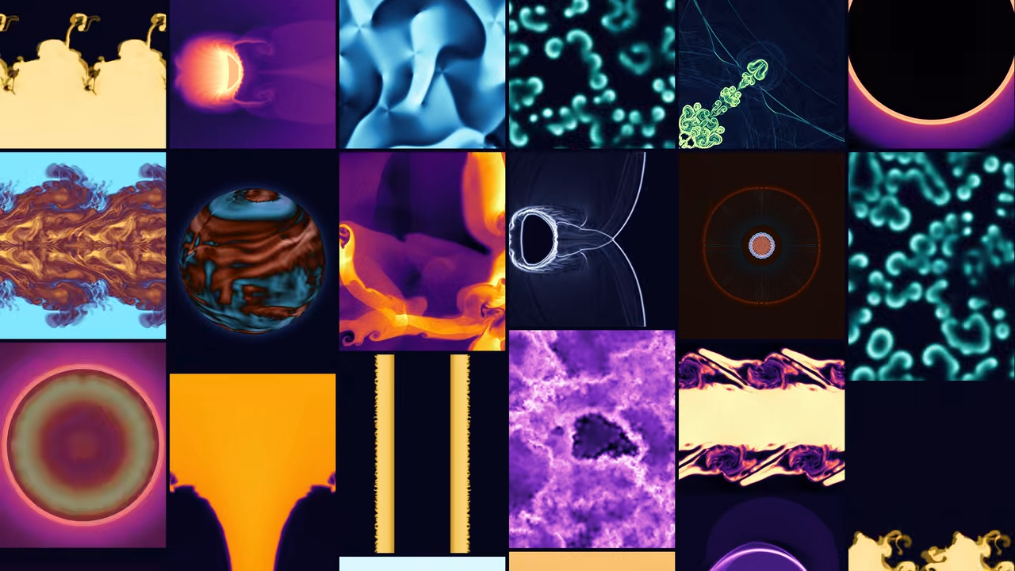
Today, we introduce Nova, the first world model for extreme physics. Nova is pretrained on a heterogeneous collection of physical systems spanning plasma physics, fluid dynamics and more, across different simulation codes, spatial resolutions, time horizons, scales and dimensions. Given an initial state, the inputs and actions that drive a system and its design parameters, Nova predicts how it evolves. It can adapt to operating regimes outside its pretraining data with a handful of simulations, and in some cases without any new simulations at all.
Fusion is a particularly demanding proving ground. It brings together many of the physical processes Nova learns to model, and better predictions could help engineers develop a major new source of energy. Before an experiment is run, choices such as the drive current, laser pulse and applied magnetic field have to be fixed. The usual way to make those choices is to iterate with a solver, but each solution requires large amounts of compute, while the space of configurations worth exploring is vastly larger than anyone can afford to simulate.