TL;DR / Executive Summary
- SpaceX’s Starship completed its 13th test flight from Starbase in Texas.
- Starship is designed to carry far more payload than current commercial launch vehicles and could significantly reduce launch costs.
- Lower launch costs could enable larger satellites, new space infrastructure and more ambitious human spaceflight missions.
- Interest in SpaceX remains high, with Starship viewed as a key project shaping the future of the space economy.
The Mission
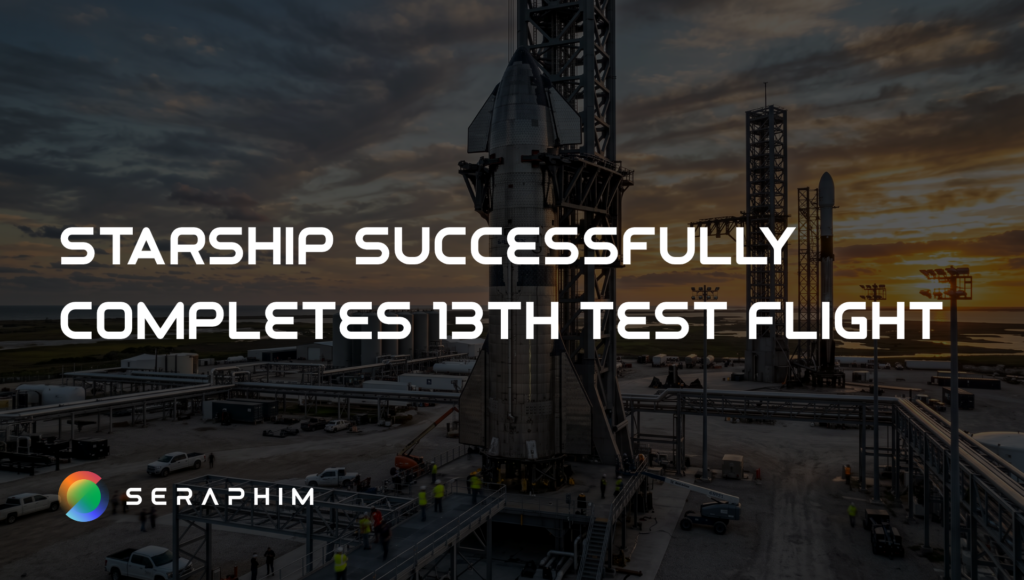
On 24 July, SpaceX’s Starship successfully completed its 13th flight, launching from Starbase, the company’s production and launch facility in southern Texas.
The mission marked the second flight of Starship V3 and the first deployment of Starlink V3 satellites by the vehicle. After lifting off at 5:51pm local time, Starship successfully completed its planned objectives before executing a controlled splashdown in the Indian Ocean.
While successful flights are becoming increasingly routine for the programme, Starship continues to attract outsized attention from across the industry. Each launch is another step in a programme whose ambitions extend well beyond reaching orbit, and whose potential impact could be felt across the wider space economy.
Why Is Starship So Important
Starship is widely regarded as one of the most important projects in the space industry today. With up to 10 times the payload capacity of today’s leading commercial launch vehicles and the potential to dramatically reduce launch costs, Starship could fundamentally reshape the economics of accessing space. Much like Falcon before it, the programme has the potential to expand what is commercially and technically possible in orbit.
The implications extend far beyond launch. If Starship achieves the reliability, cadence and cost targets SpaceX is pursuing, entirely new markets could emerge. Larger satellites, more ambitious constellations, in-space manufacturing, lunar infrastructure and human missions all become significantly more viable when launch capacity is no longer the primary constraint.
Starship’s progress is also being closely watched by investors. Following SpaceX’s recent IPO, which saw the company raise approximately $85bn, market attention on the business has intensified, with many viewing Starship as a key driver of its long-term growth ambitions.
Learn more about Starship on SpaceX’s website here: https://www.spacex.com/vehicles/starship