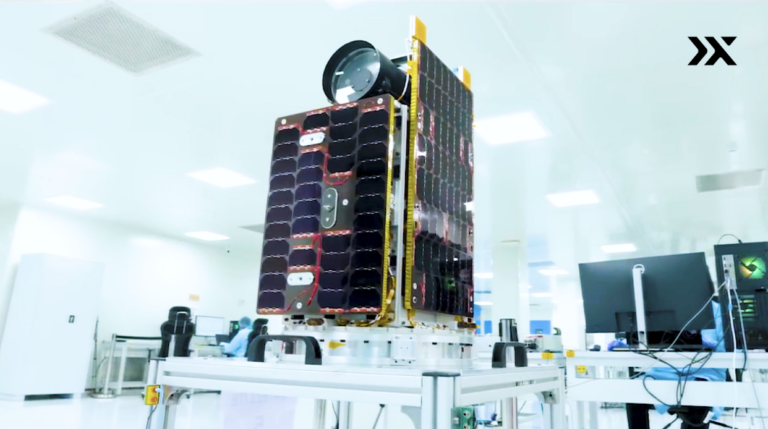
Pixxel, a Seraphim Space portfolio company, has expanded its Firefly constellation by launching three more satellites aboard SpaceX’s Falcon 9 NAOS mission. With six Pixxel Firefly satellites now in orbit, the company has achieved daily hyperspectral looks at any place on Earth. This milestone cements Pixxel’s role as a leader in space-based Earth intelligence.
For Seraphim, this represents exactly the type of breakthrough we look for: companies that transform advanced space technologies into tools with both commercial and societal value.
Each Pixxel Firefly satellite is effectively a precision instrument for measuring the planet’s health. Unlike conventional satellites, which capture images in only a handful of colour bands, Fireflies observe more than 135+ spectral bands at 5-metre resolution across a 40-kilometre swath.
That capability means:
- Farmers can anticipate yield changes weeks in advance by detecting crop stress early.
- Water managers can identify pollution sources faster and more accurately.
- Resource companies can map mineral deposits with higher confidence.
- And more…
By doubling its constellation, Pixxel has transformed hyperspectral imaging from snapshots into a predictive system. Instead of simply reacting to events like drought, deforestation, or industrial leaks, users can anticipate change before it escalates.
This predictive capability gives the Pixxel Firefly system clear dual-use value. Government agencies can apply it to areas such as climate resilience, while commercial markets gain advantages in sectors like agriculture and resource management. Positioned at this intersection, Pixxel is addressing both public need and commercial opportunity.
Awais Ahmed, CEO and Founder of Pixxel: “With six Fireflies in orbit, the planet itself becomes a living laboratory. What was once invisible is now measurable, and what is measurable can finally be changed. For a better world for all to come.”
Kshitij Khandelwal, CTO and Founder of Pixxel: “This expansion of our fleet of Fireflies proves that we can successfully build, deploy, operate, and scale up the world’s highest resolution hyperspectral satellite constellation to reach more customers at a higher revisit.”
The Firefly constellation is only the first step. Pixxel is preparing its Honeybee satellites, which will expand into short-wave infrared (SWIR) and deliver even richer insights. Combined, Fireflies and Honeybees will act as a daily health monitor for the planet.
For investors, the Pixxel Firefly expansion represents a maturing business model: proven hardware in orbit, clear market demand, and relevance across both commercial and government sectors. With Seraphim’s backing, Pixxel is building not just satellites, but the future of predictive planetary intelligence.